
1.2 Cyclization Strategies for Cyclic‑Peptide Synthesis
The formation of naturally‑occurring cyclic peptides generally relies on reactions between two reactive groups via lactamization, lactonization, thiolactonization or disulfide‑bond formation. According to the positions of the two reactive groups within a peptide, peptide cyclization is commonly classified into four categories: head‑to‑tail, head‑to‑side‑chain, side‑chain‑to‑tail, and side‑chain‑to‑side‑chain (Figure 1).
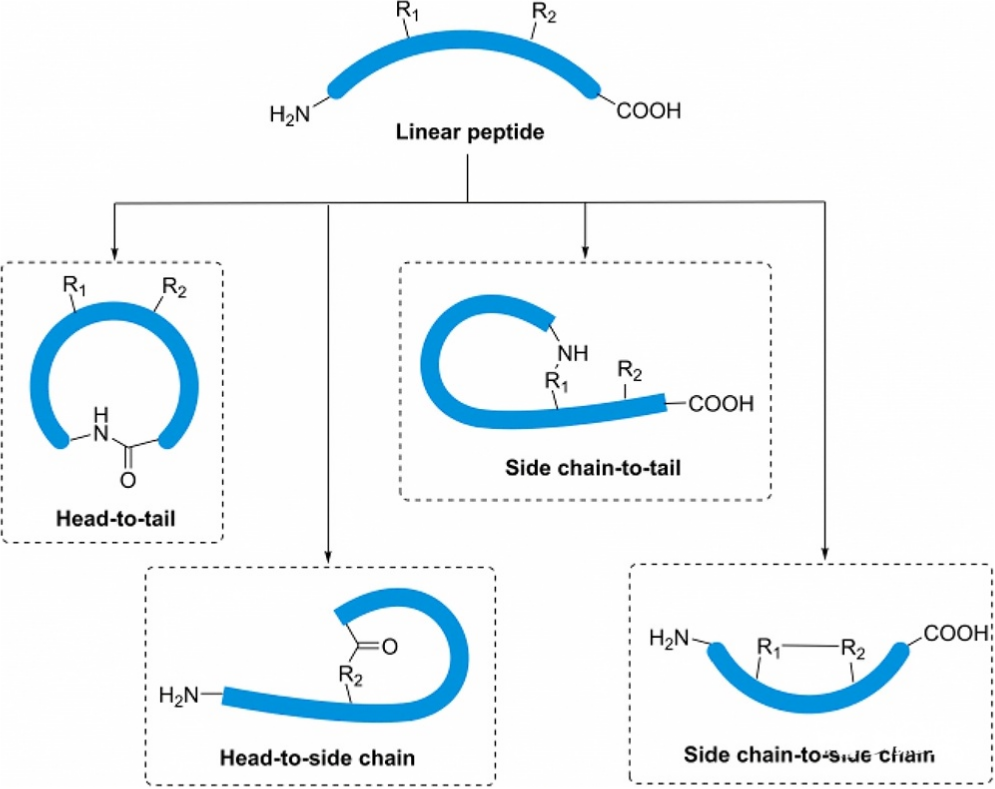
Figure 1 Four types of cyclic peptides
For head‑to‑tail cyclic peptides, macrocyclization proceeds through lactam formation between the N‑terminal amino group and the C‑terminal carboxylate group of a linear precursor. Apart from the two peptide termini, side‑chain amino groups of Lys, side‑chain carboxyl groups of Asp or Glu, hydroxyl groups of Ser and Thr, as well as the functional groups of Cys are common functional groups participating in macrocyclization reactions for the other three cyclic‑peptide types. Beyond functional moieties at peptide termini and side‑chains, peptide cyclization may also involve functional groups installed on the backbone N‑α atoms. This non‑canonical backbone‑N peptide cyclization depends on the use of functionally N‑alkylated amino acids.
Many natural peptides undergo head‑to‑tail cyclization. Compared with other peptide subtypes, such cyclic peptides resist hydrolysis by exopeptidases and therefore exhibit improved metabolic stability. This manuscript mainly describes head‑to‑tail cyclization enabled by chemoselective peptide‑ligation methods. Nevertheless, when reactive functional groups are introduced onto the side‑chains of internal amino‑acid residues, the methods summarized herein are generally applicable to preparing the other three cyclic‑peptide classes illustrated in Figure 1. Readers may refer to recent reviews on synthetic stapled peptides and bicyclic‑peptide strategies, two additional promising peptide families whose macrocycles are formed via side‑chain functional moieties.
Cyclic‑peptide synthesis faces multiple challenges. Apart from epimerization at cyclization sites with non‑Gly/non‑Pro C‑terminal residues, oligomerization caused by intermolecular reactions constitutes another major complication. Amide bonds adopt a highly stable all‑trans conformation; linear precursors lacking turn‑inducing motifs tend to adopt extended conformations. Consequently, the N‑terminus and C‑terminus of a linear peptide remain spatially separated, disfavoring intramolecular reaction. Solubility of the peptide precursors in reaction solvents represents another practical hurdle.
The discovery and extensive biological evaluation of bioactive cyclic peptides have highlighted their therapeutic potential, driving chemists to develop efficient synthetic protocols for cyclic‑peptide preparation. Conventional peptide cyclization using amide‑coupling reagents requires fully side‑chain‑protected peptide substrates. Peptide aminolysis enables cyclization with partially side‑chain‑protected peptides. The toolkit for peptide cyclization has expanded rapidly over recent decades. Cyclization starting from unprotected peptide precursors is also achievable by adopting chemoselective‑ligation strategies that tolerate unmodified side‑chains.
1.2.1 Peptide Cyclization via Direct Coupling of Fully Side‑chain‑protected Peptides
Solution‑phase direct coupling of fully‑protected linear precursors (except for the two termini designated for cyclization) with coupling reagents constitutes a standard route for cyclic‑peptide synthesis. This strategy, however, suffers from drawbacks that compromise synthetic efficiency. First, cyclization must be carried out under high‑dilution conditions to suppress oligomerization originating from intermolecular reactions, because peptide macrocyclization is entropically unfavorable. Second, activated C‑terminal carboxylic acids (except for Gly and Pro residues) are prone to epimerization, yielding a mixture of cyclic epimers. Epimerization of activated C‑terminal carboxylates primarily arises from oxazolone formation, which causes loss of chirality at the α‑carbon upon ring‑opening and generates epimeric products. A less prevalent epimerization pathway proceeds via α‑deprotonation under basic conditions to enolize the activated C‑terminal carboxylate. Numerous coupling reagents have been developed to minimize epimerization during amino‑acid activation. Third, many fully‑protected linear‑peptide precursors exhibit poor solubility in organic solvents, preventing productive reaction. Additives or mixed‑solvent systems can improve solubility, yet no universal solvent dissolves every peptide precursor. The macrocyclization efficiency of direct‑coupling protocols is heavily sequence‑dependent. Given these limitations, reaction conditions must be carefully optimized case‑by‑case to improve cyclic‑peptide yields.
To prevent undesired intermolecular reactions without employing large‑volume, highly‑diluted reaction mixtures, on‑resin cyclization has been developed. Immobilizing linear precursors onto a solid support creates pseudo‑dilution conditions that minimize oligomerization of linear peptides. Two variants of on‑resin head‑to‑tail cyclization via direct coupling exist, depending on the anchoring logic. Peptides can be tethered to resin either through the side‑chain of a trifunctional amino acid or through the N‑α atom of the C‑terminal residue (except Pro). Orthogonal deprotection unmasks the C‑terminal carboxylate for cyclization. After on‑resin cyclization via direct coupling, global side‑chain deprotection followed by cleavage from the solid‑support furnishes the target cyclic peptide (Figure 2a and 2b). Even so, epimerization at non‑Gly/non‑Pro cyclization sites remains a persistent risk. As an alternative, head‑to‑tail cyclic peptides can be generated by on‑resin aminolysis, which is addressed in Section 1.2.2 (Figure 2c).
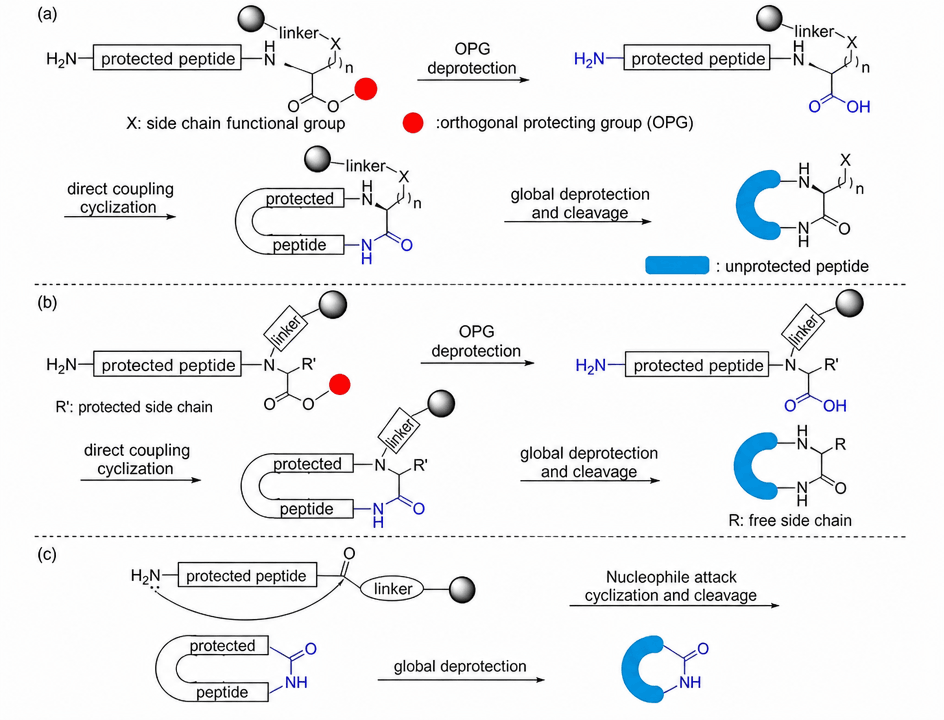
Figure 2 On‑resin synthetic routes toward head‑to‑tail cyclic peptides: (a) peptide anchored to resin via the side‑chain of a trifunctional amino‑acid residue; (b) peptide anchored to resin via the N‑α atom of its C‑terminal residue; (c) cyclization triggered by nucleophilic attack of the N‑terminal amine, which concurrently cleaves the cyclic peptide from resin.
1.2.2 Peptide Cyclization via Intramolecular Aminolysis of Partially Side‑chain‑protected Peptides
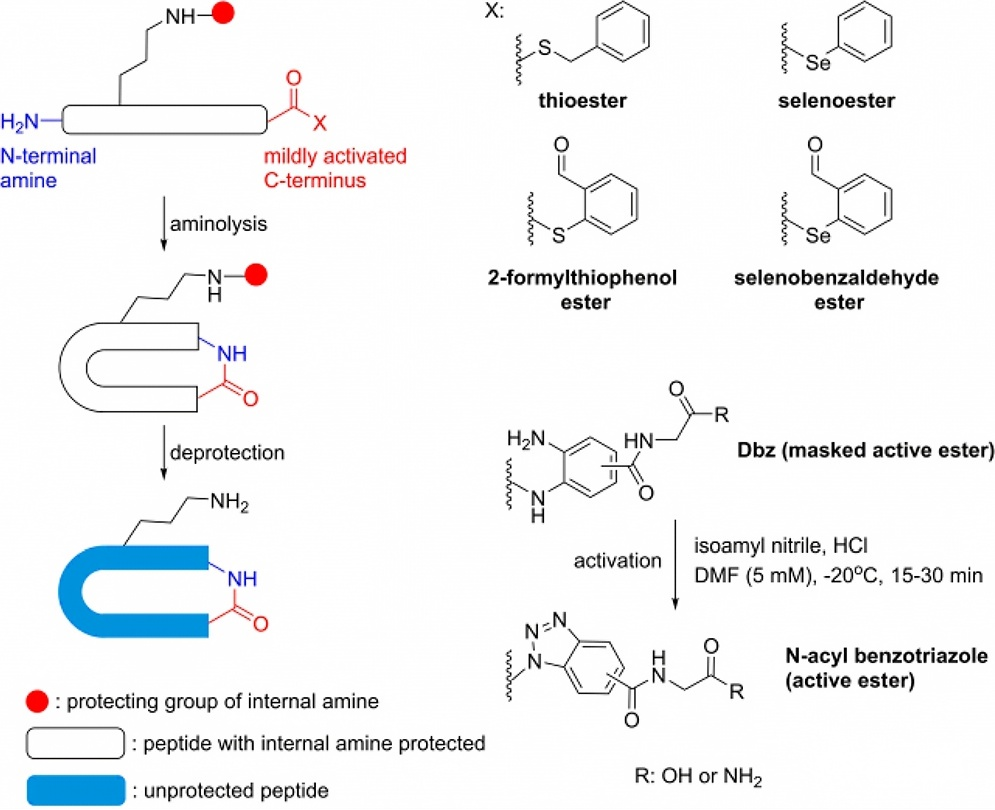
Figure 3 Aminolysis‑mediated peptide cyclization. Representative mildly activated esters competent for aminolysis are displayed.
Aminolysis reactions between partially‑protected linear peptides and mildly activated C‑termini can afford head‑to‑tail cyclic peptides (Figure 3). Houghten and co‑workers synthesized a panel of 5‑ to 11‑residue cyclic peptides as well as the natural cyclic peptide tyrocidine A via direct intramolecular aminolysis. Using fully unprotected peptide thioesters in mixed acetonitrile‑aqueous‑imidazole solution, target cyclic peptides were obtained with yields ranging from 15 % to 46 %. Unfortunately, this protocol cannot discriminate between the N‑terminal amine and internal amines within unprotected linear peptides. Side‑chain amino groups of internal lysine residues and other internal amines can react with thioesters, producing a mixture of head‑to‑side‑chain and head‑to‑tail cyclic peptides (Figure 4).
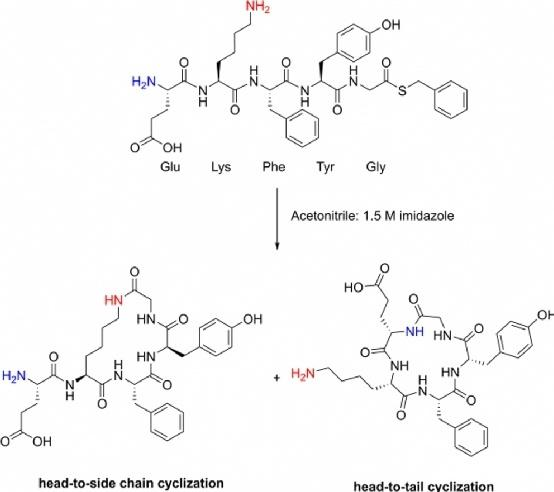
Figure 4 Regioselectivity study by Houghten and co‑workers: aminolysis‑driven cyclization of C‑terminal thioester peptides, where both the N‑terminal amine and side‑chain amines undergo reaction.
Accordingly, amino groups not intended for cyclization must be orthogonally protected relative to other side‑chains, with deprotection performed post‑cyclization. The principal drawback of aminolysis‑mediated cyclization is epimerization, which commonly occurs at non‑Gly/non‑Pro cyclization junctions. Literature reports demonstrate that epimerization magnitude is cyclization‑site‑dependent. Additives such as HOBt or HOAt can mitigate but cannot completely eliminate epimerization.
Aminolysis‑mediated peptide cyclization can also be executed on solid‑support to prepare head‑to‑tail cyclic peptides. Amine‑labile linkers (“safety‑catch linkers”, e.g. the Kenner safety‑catch linker) are attached to resin and serve as resin‑tethered mildly‑activated esters. Cyclization is initiated by nucleophilic attack of the N‑terminal amine, simultaneously triggering peptide cleavage from the solid‑support (Figure 2c).
Post time: 2026-11-19